Fake Leather Watch Straps — What They Actually Are
Vegan, PU, microfiber, synthetic — the actual breakdown of non-leather watch straps and when they make sense.
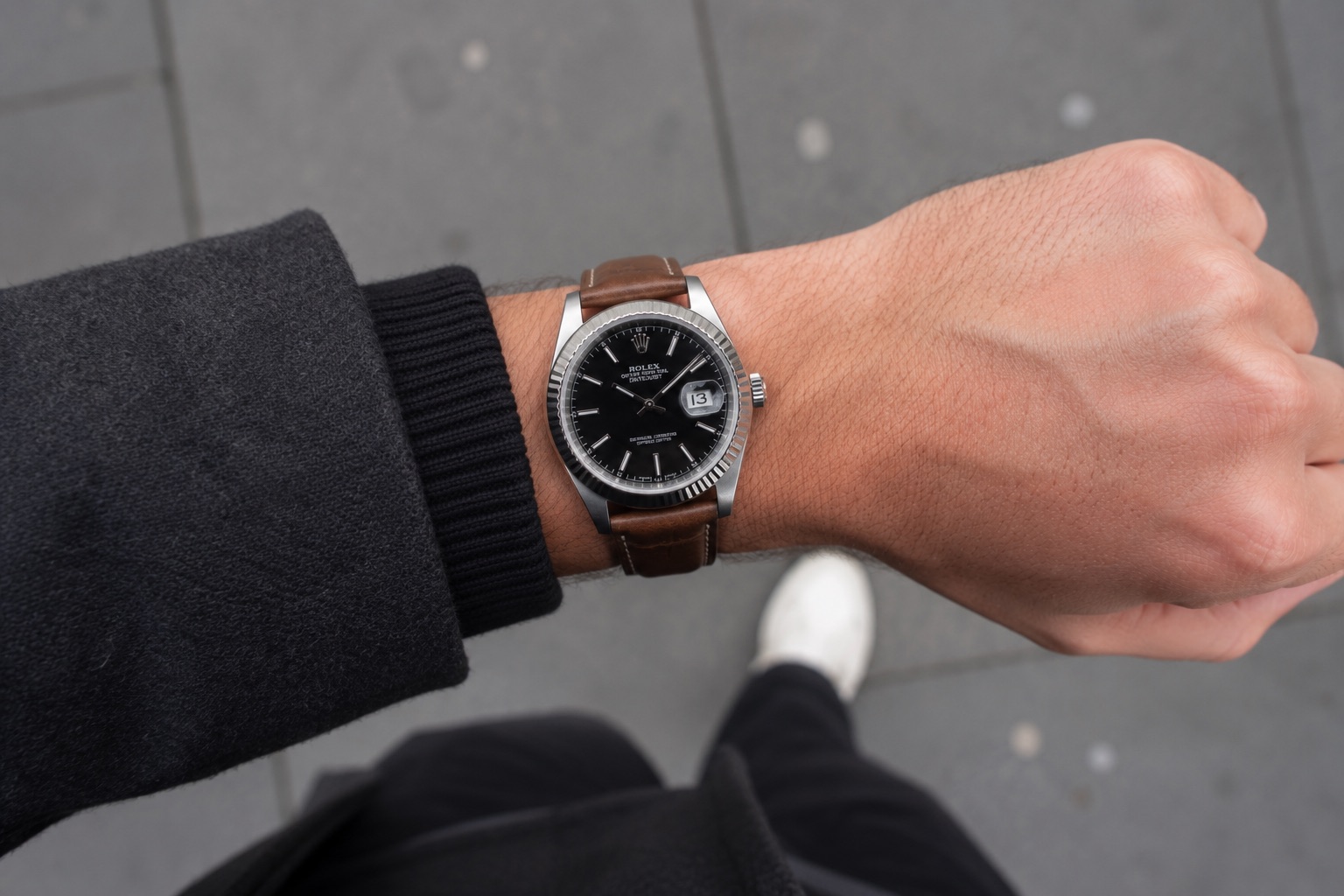 Fake Leather Watch Straps — Explained
"Fake leather" is a confusing term. It can mean three very different things: synthetic leather alternatives (vegan, PU, microfiber) that are legitimate products in their own right; low-grade "genuine leather" (split-grain leather with synthetic coating); or counterfeit straps falsely sold as a luxury brand's product. This guide covers the first two — the legitimate synthetic alternatives and what "genuine leather" actually means at the cheap end. We don't cover counterfeit branded straps, which are illegal and not what you're looking for.
The legitimate synthetic leather alternatives
Vegan leather: A catch-all term for any leather alternative made without animal hide. Most vegan leather watch straps are PU (polyurethane) or, less commonly, plant-based materials like cork, apple skin, or pineapple leaf fiber. PU vegan leather looks and feels like leather, doesn't require animal products, and is generally water-resistant. Price range: $5–$15. PU leather (polyurethane): The most common synthetic leather. A thin polyurethane coating bonded to a fabric backing. Looks like leather, costs less, doesn't absorb water, but doesn't patina the way real leather does — it just wears out. Lifespan: typically 1–2 years of daily wear before visible cracking or peeling. Price: $4–$10. Microfiber leather: A higher-grade synthetic. Uses ultra-fine polyester fibers compressed and coated to create a leather-like surface. More durable than basic PU, more breathable, less prone to peeling. Used in some premium aftermarket Apple Watch straps. Price: $10–$20. Bonded leather: Real leather fibers mixed with PU and bonded to a backing. Technically contains leather but performs more like PU — peels and cracks over time. Avoid for daily wear straps. Price: $3–$8. All four of these are legitimate strap materials. They're not counterfeits — they're synthetic alternatives. The honest label varies by listing.
What 'genuine leather' actually means on cheap listings
The phrase "genuine leather" sounds premium but is actually a specific (low) grade in the leather hierarchy. From highest to lowest: 1. Full-grain leather — the top layer of the hide, untreated surface. Most durable, patinates beautifully, most expensive. 2. Top-grain leather — full-grain with the surface lightly sanded. Slightly less durable than full-grain but more consistent in appearance. 3. Genuine leather — the layers below top-grain, often with a coating applied to mimic the look of higher grades. Real leather, but the lowest-quality real leather. 4. Bonded leather — leather fibers mixed with synthetic binders. Barely counts as leather. 5. PU / vegan leather — fully synthetic. A $5–$10 affordable strap labeled "genuine leather" is honestly labeled — it just isn't great leather. Lifespan is 6–18 months of daily wear before noticeable degradation. Compared to PU at the same price, genuine leather has slight advantages (breathes better, can absorb conditioner) and slight disadvantages (still ages relatively poorly, can crack at flex points). For occasional-wear straps, genuine leather is fine. For daily wear, spend $15+ for top-grain.
When 'fake leather' is the better choice
Synthetic leather genuinely outperforms real leather in several scenarios: Wet environments. Vegan/PU leather doesn't absorb water. Real leather absorbs water, swells, then dries stiff and brittle. If you're going to wear the strap during swimming, showering, or in heavy rain, synthetic is the better choice (or use rubber instead). Vegan preference. Some watch enthusiasts avoid leather for ethical reasons. PU and plant-based alternatives provide the look without the animal product. Ultra-low budget. A $5 PU strap works adequately for a year. A $5 "genuine leather" strap works similarly. Both will need replacement; both look acceptable when new. Humid climates. Real leather develops mold and mildew in persistent humidity. PU and microfiber don't. Apple Watch / smartwatches. For watches that get heavy daily wear and frequent contact with skin sweat, synthetic alternatives often last longer than budget real leather. The price-equivalent comparison ($15 microfiber vs. $15 generic leather) tends to favor microfiber for active wear.
When real leather is worth the upgrade
Real leather wins decisively in these scenarios: Dress wear with developing patina. Real leather darkens and softens with use in a way that synthetic can't replicate. If you want a strap that looks better at 2 years than at 6 months, you need real leather. Premium feel for premium watches. There's a tactile difference between top-grain leather and PU. On a $2,000+ watch, the strap is part of the experience. Synthetic looks fine; real leather feels nicer. Long-term ownership. With proper conditioning, mid-grade real leather lasts 3+ years. PU rarely lasts beyond 2 years before cracking. For straps you'll keep, real leather is more economical over time. Character. A favorite real-leather strap develops marks, scratches, and color shifts that tell a story. Synthetic leather just wears out evenly. If your budget is $15+, real leather is almost always preferable to synthetic. If your budget is $5–$10 and the strap is going through hard daily wear, synthetic can be the more durable pick.
How to spot the difference in budget listings
other sites doesn't always clearly label synthetic vs. real leather. The cues: Real leather listings typically say "full grain," "top grain," "calfskin," "cowhide," "crazy horse," "oil tanned," or "vegetable tanned." These terms aren't used for synthetics. Synthetic leather listings typically say "PU," "vegan," "microfiber," "synthetic," "faux," or simply don't mention the material grade at all. "Leather" alone (without "genuine," "top grain," etc.) is ambiguous and could mean either. Check the description carefully. Price signals: under $5 is almost always synthetic or bonded. $5–$10 is split between PU and "genuine leather" grade. $12–$25 is usually top-grain leather. $25+ is typically full-grain or specialty leather. Look at the back of the strap in photos. Real leather has a fibrous, slightly fuzzy backing. PU has a smooth fabric or plastic backing. Microfiber has a synthetic suede-like backing.
Frequently asked questions
Is 'vegan leather' the same as 'fake leather'?
"Vegan leather" is one type of leather alternative — specifically, one made without animal products. Most vegan leather is PU (polyurethane), though some is plant-based (cork, apple skin, mushroom leather). The term "fake leather" is sometimes used pejoratively for any non-real-leather, but the legitimate framing is "synthetic leather" or "leather alternative." These are real products with real use cases, not deceptive imitations. The deceptive imitations are products marketed as real leather that aren't — which is a different problem (mislabeling) than legitimate synthetics.
How long does a 'fake leather' / PU watch strap actually last?
PU watch straps typically show visible degradation (surface cracking, peeling, fraying at edges) after 12–18 months of daily wear. Light wear (occasional) extends this to 2–3 years. Microfiber lasts longer — 18–30 months of daily wear before noticeable wear. By comparison, mid-grade real leather lasts 18–36 months of daily wear, and premium real leather lasts 3–5+ years with conditioning. The lifetime cost difference is meaningful: a $15 PU strap replaced annually vs. a $25 real leather strap replaced every 2 years works out to similar total cost.
Can I tell if a strap is real leather from the smell?
Sometimes. Real leather has a distinctive smell — earthy, slightly musky, neutral. PU and synthetic alternatives have either no smell or a faint plastic/chemical smell. Bonded leather can smell like real leather initially but the smell fades faster. The catch: some real leather is heavily treated with chemicals during dyeing and finishing, which can mask or replace the natural leather smell with a chemical one. Smell alone isn't a reliable test, but it's a useful signal alongside the visual and tactile checks.
Are there 'fake leather' straps that look indistinguishable from real leather?
Premium microfiber leather can be very hard to distinguish from real leather without close inspection. Some Apple Watch bands in the $30–$60 range use microfiber that looks and feels like quality calfskin. PU at the cheap end ($5–$10) is almost always identifiable as synthetic — the surface has a slightly plastic sheen and the edges look obviously cut rather than burnished. For watch enthusiasts, the visual difference becomes obvious quickly, but for general wear, mid-grade synthetic is convincing enough that nobody but you will know.
Find a dupe for a specific strap
Paste a product URL from any premium strap brand and we'll match it to affordable alternatives.
Try the tool →